Showing posts with label stuff that works. Show all posts

Monday, March 6, 2023

seatbag organizer bag


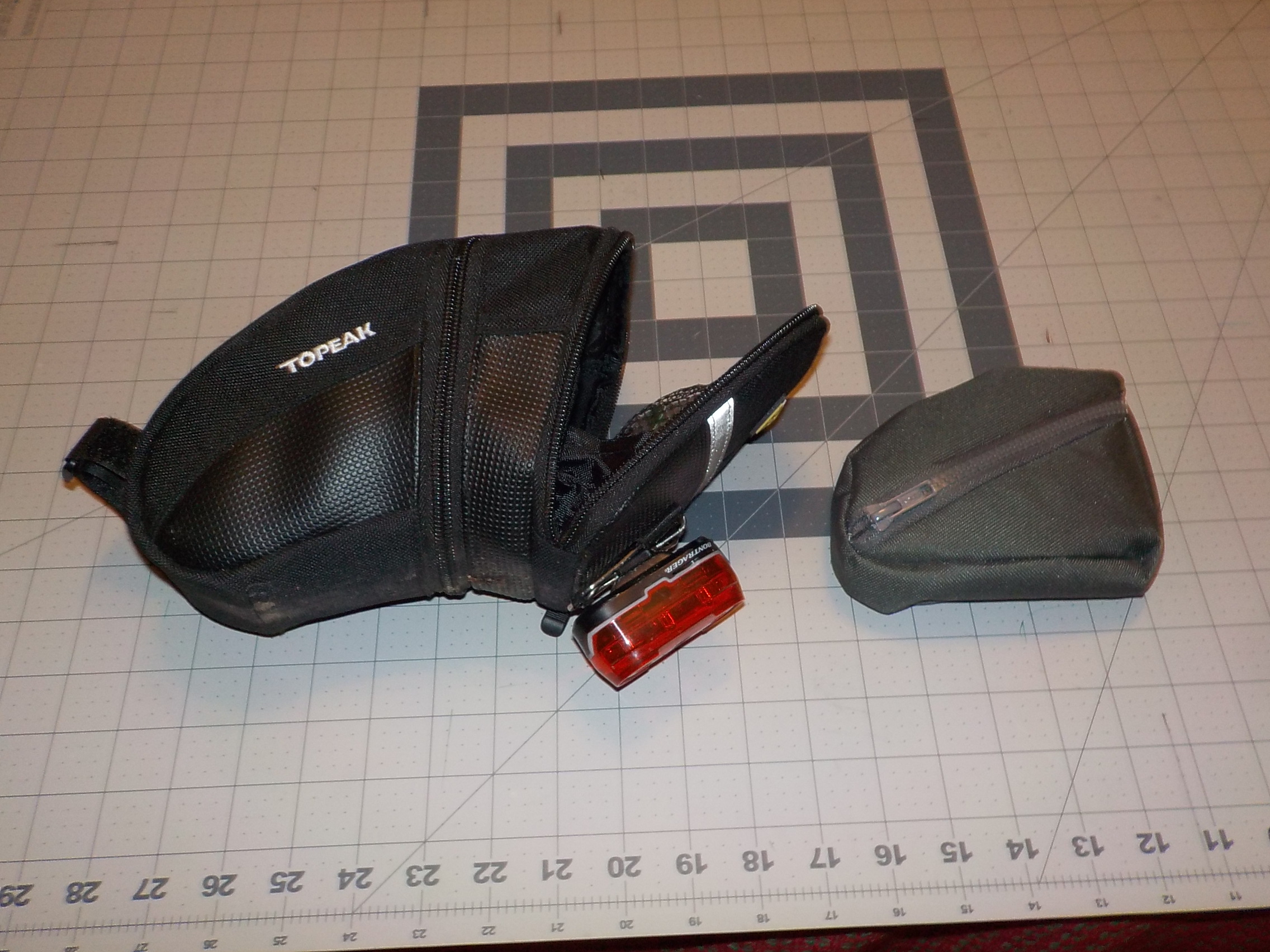
A year ago, I made a seatbag organizer bag custom fit to that extra-large Topeak Aero-Wedge bag that I (along with a number of other Free Wheelers of a certain age) like to carry (we're past the point where we're trying to get by on the lightest of bikes and baggage, and well into the "rather have it and not need it, than need it and not have it" mindset).

Although it fit nicely into the seatbag, there were two things I never liked about it. The first is that I'd made it just a bit too small to get everything I like to carry. The other is that I'd used a brass blue-jeans zipper, and it never worked smoothly. Over the weekend, the zipper simply locked up; I had to tear the bag open (although I could still sorta use it), so I resolved to make another. 

Having the old bag, I could use it as a pattern. I made the shaped sides about 3/8" longer. The sides are held together by a long, narrow rectangle of fabric. On the first one, I made that 1" wide plus the seam allowances; this time I raised that to 1 1/2". And I had a plastic zipper in the drawer that hadn't been used on a project that I thought better of before I'd actually bought the fabric for it.


Above, from lower left: one side cut apart with the zipper installed, the other side for the new bag; the side of the old bag that I'd used as a pattern. (Note to self: that right-side-to-right-side-and-fold-it-over zipper trick works a treat.)


The outer rectangle is sewn onto the side with the zipper in the picture above; the other side is at top, under the orange-handled trim shears.

Above, same as the previous picture, but other way up.


All sewn up in the picture above. I need to trim the outer rectangle piece (measuring around those curves is a PITA; I decided I'd just make the piece long and trim the excess. Your sewing teacher would not have approved). The piece is worked inside out; leave the zipper open and turn it right-side-out when done. You can see the finished product, filled, in the top photo.

What's in it?

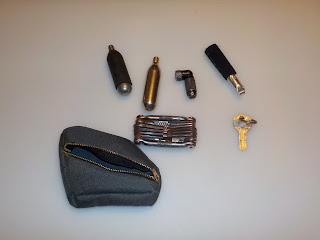
The stuff on the right. From top:

  • Tire Glider tire tool*. Theoretically better than just levers for removing and replacing tires (and it is, when it fits, but see below).
  • Crank Brothers M19 multi tool. It includes a chain tool and spoke wrenches, as well as the Allen keys, screwdrivers, and a common Torx size, but the Allen keys and screwdrivers are sometimes too short. When somebody finds a multi tool that includes all this stuff, with regulation length screwdrivers and such, that is NOT made by Silca or some other bicycle jewelry company, I'll get one.
  • A CO2 cartridge.
  • A box from a tire patch kit, that actually contains quick links for 9- and 10-speed chains (I know from experience that I can use a 10-speed link to repair an 11-speed chain). I've used 'em twice for others who have broken chains en route. (I find tire patch kits are useless at roadside, despite the many recommendations. Use 'em if you're doing self-supported touring; otherwise, use Uber. YMMV.)
  • Another CO2 cartridge.
  • Lezyne aluminum tire levers. They're beautiful, and stand up to tight tires better than the plastic ones. (I'm lookin' at you, Continental Tires...)
  • Genuine Innovations Air Chuck CO2 inflator. I've tried a bunch, and seen more. This is one of the original designs, and it works. Period. 
  • Lezyne spoke wrench. I bought this at Wheelfine Cycles when I'd spent far too much time picking Michael's brain and wasting his time, and felt I needed to part with some cash to justify it.
  • House keys. (I also have a set in my wallet. And in the car. There's a story in it.)

 NOT in the bag are two tubes (shown), a set of Allen keys, and some tire boots.

I like this bag way better than the old one. 

*Tire Glider. It's worked sometimes, and the theory is great, but the notch that the wheel wall goes into when the tire is being replaced is too tight for some wheels. I've recently come across the Tire Monkey, with a wider notch for the wheel wall, and generally beefier construction overall. I've not used it yet, but I have high hopes. (Your best bet might still be the Kool Stop Tire Jack. I've got two. For the really reluctant tire, I've used the Tire Glider to keep the bead from falling off with my left hand, and the Kool Stop jack to force the tire on with my right. Don't get me started on Continental tires and tubeless-ready wheels.)


Friday, March 3, 2023

too soon to tell, but suggestive, nonetheless

To satisfy a nagging little suspicion, I had my doctor send me the heights they had on file for me for the last three years.

There was no change in that little bit of time, but I'm an inch shorter (about 25mm) than I was in college. I'd thought I was still that height, but I'm not.

Over the past two weeks, I've lowered my saddle height by 10mm. Today, with no carbs for breakfast (just a couple hard-boiled eggs, and the quart-and-a-half of coffee I have every day), I turned in this ride:

Holy bananas; 15.6 average. That about a mile-an-hour faster than any ride I've done recently.

The sample size is too small, of course, and correlation is not cause, but this result is suggestive, nonetheless.

Monday, February 27, 2023

bad idea carbon fiber bike parts


See the original on YouTube. 

Carbon fiber has a far better reputation than it did when I was building the titanium Yellow Maserati, but I still avoid it (link goes to the site at Busted Carbon, although I doubt any carbon-fiber fans will click on it). It turns out that Francis Cade, who's far from a retrogrouch like me, posted a video with expert opinion on parts that should not be carbon fiber.

I'm stickin' to my opinion: I don't ride no plastic bikes.

Saturday, February 25, 2023

not for its intended purpose


 I've "come out" as both a person in recovery from a substance-use disorder (holy crap; that post was eleven years ago) and as a person with a mental health disorder.

I do daily exercise, and, if I'm exercising in the house, I listen to podcasts. During the pandemic isolation, the Home Cooking podcast, from Samin Nosrat and Hrishikesh Hirway, was running (and they did two Thanksgiving episodes thereafter).

I'm never going to be much of a cook, but I treasured this podcast. I found Samin's voice, and her laugh, and the interaction between her and Hrishi, soothing and comforting.

I'd save up these episodes for particularly bad days. Much of my anxiety was work-related, so after I retired, I didn't need the soothing as much, and I had two episodes I hadn't listened to yet.

This week was pretty bad (I may do a post about that), and I played one of the remaining episodes today. It still worked as I remembered. My mind is better. And there's one more in the can, and I've still got all the other episodes I can replay, if I need.

Ms Nosrat will probably never know (or, likely, care) how helpful she's been. But this podcast saved me on some of my darkest days. 

I do a daily (well, more-or-less) discipline about remembering what to be grateful for and what I need to focus on each day. Today, this podcast is going on the gratitude column.

Friday, February 17, 2023

chance of dying

 A micromort is a unit of risk defined as a one-in-a-million chance of death.

According to this page, cycling 28 miles in a day incurs a risk of one micromort.

This page tells me that getting out of bed after age 45 incurs a risk of six micromorts. Going for a swim risks twelve; playing football (the American flavor, "handegg") risks 20.

You can keep your benighted high-viz-yellow cycling gear. Put that high-viz-yellow on your swim trunks and football jerseys. 


Wednesday, January 25, 2023

new cycling jersey


It's a shame I look like a dentist in scrubs in that picture, because that jersey pattern came out well, and is probably one or two iterations away from what I really want.

Yeah, I'm working on making my own jerseys. I'm not paying for the good ones, and I don't like the fit of the cheap ones, and I don't like the zippers. I'm never gonna pull down that zipper; keeping my scrawny, grey-haired chest covered is a spiritual work of mercy and a service to the community.

The fit is good; the pockets are deep in back without being so high at the waist that it's hard to reach into 'em. The fabric is sweat-wicking, and a good weight: not heavy, not too flimsy.

Regular readers know that I started sewing during the pandemic. When you start sewing, you wind up making an awful lot of stuff that turns out to be only good for rags. This is probably my tenth jersey, and I only have one other that I'd actually wear. I made two for fellow club members, but those had zippers in, and for the zippers and for other reasons, I'm not really happy with those.

There are a couple of more details I need to work on. But expect to see that seafoam jersey when then weather warms. (I might try a long-sleeve version next...)

On Facebook, I saw ads for this Ocean & San; one of their slogans is "Looks like a shirt; rides like a jersey" (they use a comma instead of the semicolon, but don't worry; I corrected 'em).  That's kind of the vibe I think I'm going for. It's recently come home to me that almost nobody I ride with or hang around with has the same ideas about bikes, cycling, or accessories as I do. Oh, well.

Saturday, December 31, 2022

on affordable bikes

 On a recent ride, several of the Insane Bike Posse were discussing how many bikes we had. The range was pretty wide: one rider has, I think, nine (Edit: I've been informed the number is five). I was the low end; I have two: the Krakow Monster, my gravel/monstercross bike, with two-inch-wide tires, built on a heavy steel Surly Cross Check frame; and the Yellow Maserati, my titanium road bike.

Knowing about my love for mechanic work, and for the beautiful lugged-steel frames, my co-riders found this hard to believe, but it’s true: I don’t have any other bikes. (We’re not counting the road bike and the hybrid that my wife has; I don’t ride those.) So the next question was about my parts collection.

I thought I had about seven wheels that were not attached to bikes (I just checked; there are actually nine, and two rims that haven't been built up into wheels yet), along with:

  • Two sets of cranks;
  • Three pairs of pedals;
  • Four sets of shifters, including a pair of lever shifters that can be used on downtube bosses or as bar ends;
  • A set of road caliper brakes;
  • At least one vee-brake (supposedly a rear, but vee-brakes are interchangeable front to rear);
  • Two saddles;
  • A seatpost;
  • Three rear derailleurs;
  • Two front derailleurs;
  • And various and sundry accessories I’ve picked up here and there. As well as whatever stuff I’ve forgotten to list.


None of this includes the tubes, cable, and housing that I keep for my mechanic business.

The sense of the meeting was that these do not count as an additional bike, because there’s no frame to hang them on. But it did provide a way to start this post, which has been percolating for a long time (as you'll be able to tell by its inordinate length).

I’m friends with a rider who has a collection of bikes, mostly steel-framed, all Italian, all beautiful. They are lovely machines. I could probably afford a bike like that, but, given the limited space I have, I’m going to forgo owning one.

Other riders maintain their bikes, or collections, to have the lightest bikes, or the latest-and-greatest components (these are not always the same as the lightest!), or what the winningest pros ride. Or to have bikes for every different kind of riding they do, or ever might consider doing.

Those aren’t my interests. My bikes, and the parts I’ve collected, are really about bikes that are affordable – about a balance between cost and performance.

The titanium frame I got is a brand you’ve probably never heard of (the decals were ugly and started to wear off, so I removed ‘em). My first road bike was an aluminum Giant with a carbon-fiber fork. The fork got a scratch, and, in those days, carbon fiber had a reputation for “catastrophic failure”: breaking suddenly (often without warning), possibly causing injury to the rider. (The website at "busted carbon" hasn't been updated in more than a decade, but it was scary at the time...)

I replaced the fork with a steel fork…

...and then decided I could build up a bike myself, starting with the components from the aluminum bike, and swapping out the parts bit by bit until I had the bike I wanted. I found the titanium frame for less than $1000, with geometry and measurements I could deal with (I knew a lot less about bike frame geometry than I do now; I was lucky that the frame worked out for me as well as it did) (and the frame is still available for about $1400; some of the older model are still at the original price).

The groupset I used was a SRAM Rival set, on which I got a great price. After a few years, the shifting started getting dodgy, and I replaced it with the Gevenalle set I have now, which places modified downtube-lever shifters outside the brake levers. They’re light and inexpensive, and they also change to friction-shifting mode, which I’ve been using for a few years (and they have a few other advantages, about which I’ll happily bend your ear if you give me the slightest provocation).

I’ve also tried the Sensah Empire 2x11 groupset, a mechanical groupset from a Chinese manufacturer, which I’ll put on my wife’s bike the next time her shifters need adjusting.

All of these groupsets are reasonably-priced, and they all work well. Now I see that even lower-end components for the big groupset manufacturers are going to electronic shifting. I think this will raise the entry price for bicycling… and I hate that.

All those parts I listed above? They’re mostly things I’ve tried (like the Sensah Empire set), or things I have in stock in case replacement parts for the bikes I currently have become unavailable. (My favorite saddle was a Specialized Body Geometry that the stopped making. I wore out two of ‘em, and only replaced the last one when I fell in love with the Selle Anatomica’s that I have on both bikes now. And since manufacturers either go out of business, or change models, I have a spare Selle Anatomica saddle in the box. I hate it that bike stuff just disappears.)

I’ve got no interest in upgrading to disk brakes, or electronic shifting, because I don’t want to have to buy the new frame to hang them on, and I don’t think they’ll make me a better rider. To me, they are additional expense, without improvement for the kind of riding I do.

I’ve been on more than one ride on which electronic shifting has failed due to batteries not being charged. I enjoy complaining about that, but that’s not a real reason to avoid electronic shifting. After all, I’ve also been on rides where mechanical shifters have had problems – for example, when cables have parted. My real objection to electronic shifting is the additional cost, without (as far as I can see) substantial additional benefit.

And I really have no interest in a carbon-fiber frame. I’ve been in discussion with someone who crashed on one, and who is considering having it sent for x-ray to see if there’s unseen damage that may cause one of those catastrophic failures to which I alluded earlier. I had a pretty bad crash in 2015 on the titanium bike. There’s a dimple in one side of the top tube that’s the only remnant of that mishap; I expect that the only reason I’ll have to get rid of this bike is when I’m physically unable to get a leg over it. I’ve worked on a number of other carbon-fiber frames: two of them have wear at the chainstays as if the tire had worn off the paint layer and was cutting into the plastic that holds the carbon fibers in place. Tapping with a coin does not show weakness on those frames, but I’ve not seen anything similar on metal frames. And I’ve seen what appears to be clearcoat and paint flaking off an older carbon frame. On a metal frame, this is just cosmetic damage. Are we sure that’s the case with carbon fiber?

When I bought my titanium frame, the seller said my grandchildren would ride it. He was unaware of my childless condition, but the case is still made.

It helps, too, that I like doing the bike mechanics. I don’t do that just to keep the bikes affordable (not with the amount of money I have invested in bike tools, truing stand, bike stand, various and sundry chemicals…), but it does mean I can do things for myself in order not to have to buy new much of the time.

I wrote a post some time ago about continuing to ride a bike you love. If you have beautiful bikes, and love to ride them… I hope you ride them forever and are very happy with them. If you love the latest-and-greatest gadgetry, or the stuff that the most successful pro’s use, and you have the financial wherewithal to support those habits (and let’s face it: among the people with whom I ride, many do!), then enjoy them.

But I think cycling should be available and enjoyable to people who are not wealthy (as I am not wealthy). My bikes and equipment will be affordable, based on my interest, abilities, and cashflow.

I hope there continues to be a place for them.

Edit 1/1/23: I just found (again) a post I wrote eleven years ago on more-or-less the same topic; at the time I called it "bicycle cheapskate".

Tuesday, October 25, 2022

getting all bike-geeky about cleaniing chains, and spray cleaners generally


 That picture is an arrant fraud; I'd never use a spray-can cleaner. Pump-sprays are way more betterer.

As I noted in an earlier post, I started using paraffin as chain lube almost three years ago. The results are hard to believe: I've gotten over 4,000 miles on each of the chains I alternate for the process, and they still measure within the acceptable standard for continued use (I use cheap chains; I used to change them about every 1,000 miles; now I alternate the chains about every 500 miles or so). The process has the not-unpleasant side effect of providing a clean drivetrain; I can touch my chain, and bring my fingers away comparatively cleanly (and I like the look of the cleaner drivetrain).

Paraffin adheres nicely to the metal of the chain, but it doesn't like the dirt that invariably collects on it, so the chain-cleaning process is important. I described my initial process in the second blog post linked above. It's a multiple-day process (and, frankly, a PITA, with which most riders won't want to be bothered). On the advice of friend Eddie L, I got an ultrasonic cleaner some time ago, and he and I have been corresponding via text message about the best ways to clean chains.

I'll tell you one way that didn't work for me: I tried using a solution of Pedro's degreaser and hot water in the ultrasonic cleaner. When I put that chain in the wax, it was still so dirty that it ruined the batch of wax, which had to be discarded.  (It's not the fault of the Pedro's product; I've had great results generally with this degreaser.)

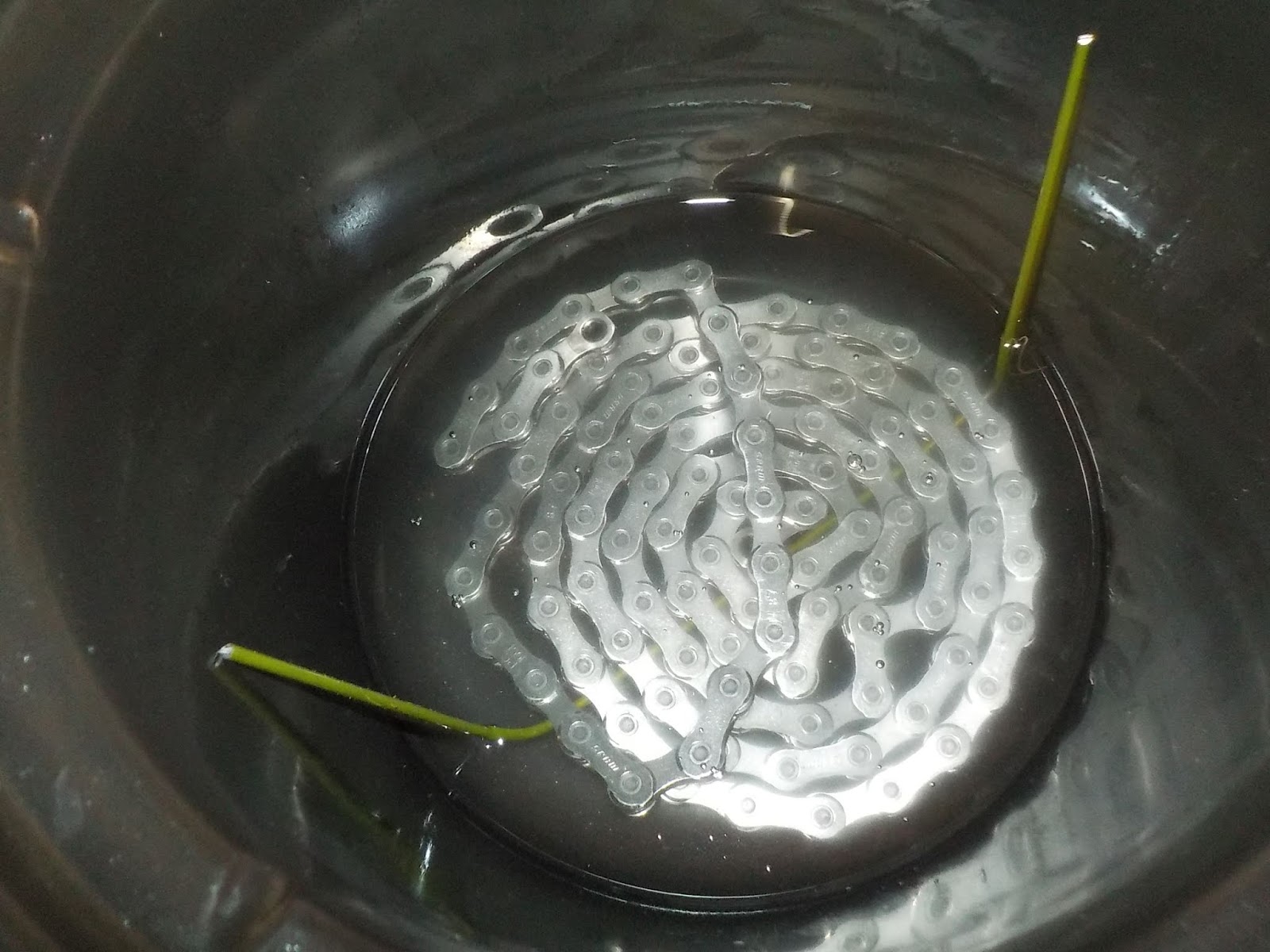
The process Eddie described to me is as follows: Soak chain in mineral spirits for a couple of hours, then put the jar with the mineral spirits and chain into the ultrasonic cleaner (you can re-use the water, and not have to clean the inside of the device, by floating the sealed jar with the solvent in the clean water in the ultrasonic cleaner). Put the chain in clean mineral spirits and agitate. Repeat until the mineral spirits are "pretty clean" (his words). Then soak in alcohol to get the last of the mineral spirits off. When dry, apply the paraffin.

He'd tried this after soaking a chain in mineral spirits for ten minutes and being amazed at the amount of black gunk that came off his (paraffin-lubed) chain.

Well, I thought of that ten-minute soak, and my experience with the Pedro's degreaser, and decided to try something different. Here's what I did:

  • Soak the chain in mineral spirits for about ten minutes, agitating lightly occasionally to ensure the mineral spirits goes all the way in.
  • Wipe the outside of the chain with a rag.
  • Put clean, hot water into the ultrasonic cleaner.
  • Put chain, hot water, and a generous dollop (maybe 2 tablespoons?) of the Pedro's degreaser into a sealable pint container. Seal the container.
  • Put the container with the solution and chain inside into the ultrasonic cleaner, and run for 30 minutes.
  • After the 30-minute session, remove and rinse the chain.
  • Repeat the previous three steps. After the second round with the degreaser solution, marvel at how clear the solution still appears.
  • Immerse the rinsed chain in alcohol, and hang to dry. 

Wow. That chain was CLEAN; I'm fairly sure I was down to bare metal. And the paraffin seems to confirm my suspicion; after the dip, the remaining paraffin is still clean.

The process takes a few hours, most of which is waiting, either for the ultrasonic cleaner to complete the session, or for the chain to air-dry.  

I'm likely to try a different degreaser; the Pedro's is expensive, and not as readily available as, for example, Zep Citrus degreaser. I'm not impressed with Simple Green as a degreaser; while it's certainly stronger than most spray-on cleaners, it's nowhere near as efficient as the Pedro's (and Simple Green sells a dedicated degreaser as well, implying that they know that the cleaner alone is not really up to the degreasing task). I used to be able to get a product called LA's Totally Awesome in the dollar stores, which I would put up against Simple Green for cleaning any day of the week. Alas, as is often the case with dollar-store products, the supply is gone, and I cannot find it any more. I mourn its disappearance.

I've been haunting the auto-parts stores looking for other degreaser products, on the theory that those engines get pretty grody, and need some heavy-duty solutions to clean 'em up, but my efforts have not, so far, borne fruit. On my last visit, I saw dozens of products for cleaning various minuscule parts of a car's interior, but nothing to suit my get-the-gunk-off desires.

I gotta get a life.

Thursday, September 29, 2022

methuselah of chains


 I gotta crow about the effect of paraffin lubrication on my bike chains.

I've found sources that say you should expect your chain to last 3,000 miles (see here and here). Now, I started waxing chains in January of 2020. I bought two inexpensive chains, cut them to length, cleaned them down to bare metal (I'm updating my procedure for that after ruining a batch of wax; look for another post about cleaning chain if you're the least bit interested), immersed them in melted paraffin, mounted one on the bike. When I got about 500 miles on the first one, I put the other on the bike, then cleaned the first and immersed it in the melted paraffin and saved the chain; I continued to replace, clean, and re-wax every 500 miles.

Since I started the process, I've put about 8,500 miles on the Yellow Maserati. Let's subtract the 500 miles for the Sensah Empire 11-speed experiment; that leaves 8,000 miles on the original chains, so each chain has about 4000 miles on it. I measured them today... and they still show less than .75% wear; they're still within specification. I plan to change them if they last to 5,000 miles, because, like, don't push it too hard.

Now, I like doing bike maintenance (as most riders probably don't), and I don't find either the cleaning process (my old method is described at the bottom of the "waxing the chain" page) or the waxing process to be onerous. Most of you will decide that your regular lubrication process, and changing chains (and maybe cassettes*) as you do is fine for your purposes. But this clean-and-wax thing has done wonders for my chain life.

*I'm still using the same cassette over all that time, too; there's been no reason to change it.

Friday, September 23, 2022

with the change in the weather...

 The weather has turned cooler with the arrival of autumn, which means I'm back to being that guy who puts on a blazer and bow tie to go to the grocery.

Thursday, September 22, 2022

good closing speech

 Youtube recently fed me a video from Psychic Derailleur through my feed. I watched it and liked it, and watched another, and liked it, and another, and now I'm smitten.

He closes his videos with a little speech: "I hope something good happens to you today. Until next time, be nice; work hard; ride bikes; play music when you can."

I like it. I might steal it.

Wednesday, September 21, 2022

sensah groupset experiment at 500 miles


Last month, I announced my intention to check out the Sensah Empire 11-speed mechanical groupset. Shimano now has electronic 105, and while mechanical 105 is still available as I write this, my fear (and experience) is that higher-priced, novel technology tends to drive away older, tried and true technology (one of my old riding buddies, Ron S, once said, "If you find a saddle you like, buy ten of 'em, because eventually they're gonna stop makin' 'em.") The cost of entry to road cycling is already too high and isn't getting any lower, so I wanted to try this Chinese-manufactured groupset I'd seen on the internet, which was getting good reviews, and which is incredibly inexpensive.

I got it from the Ali Express Sensah Empire Store (there are other stores on Ali Express that sell it... but the Chinese are famous for violating patents and trademarks of foreign companies; why would I think they'd have more integrity with another Chinese company?). The store must have US stock available, because I had the box a day or two later.

I installed as explained in my installation post. I've had it on the bike for about 500 miles, and I'm ready to have a final opinion.

Installation: As I've already explained, installation was straightforward, except that the included clamps did not fit my larger-than-specification 80's-era Cinelli bars. They will fit drop bars with the current specification; for the rest of youse, invest in a couple of these. Other than that, it was the quickest, least troublesome install I've ever done.

Performance: Shifting is quick and decisive. I like them as well as I like any index-shifting system (I don't like the "cla-DUNK" noise that announces the shift, and I don't like the fact that I can't shift four or more gears at a time in the rear, as I can with my friction Gevenalle system, to which I will be returning). A few days ago, I found that the front derailleur was not dropping to the smaller gear reliably. A cable adjustment fixed this, and it's my belief that the bike knows when the hot weather is mostly over and cooler weather is coming, and signals this by requiring a shift adjustment; similar things have been happening to me for years. It's back to behaving nicely.

I went for the set that came with the 34-tooth large gear on the rear derailleur. I never used the large gear until a ride this Saturday, on which we had a climb of about 200' in about a quarter-mile. I've gotten religion and seen the error of my ways, and will be fitting a cassette with a 34-tooth large gear on the Yellow Maserati when time and finances permit.

Aesthetics: I like the look of the Sensah set. The front derailleur is nothing-in-particular; front-derailleur-undifferentiated-type, but I like the look of the rear derailleur and the controls. The hoods have some texture molded in, and the levers have a techie look to 'em. The rear derailleur has a carbon-looking sticker on, which I could do without, but the structure is handsome.

I like the feel of the levers when I'm riding on the hoods, too. The ramps on my bars point forward and down, so there's a bit of extra weight on my hands when I'm riding on the hoods, but they support comfortably.

Cost: $174 shipped. This included shifters, front and rear derailleur, cassette, and chain (11-speed, nothing-in-particular Chinese brand). I went for the all-alloy set; it's available in carbon for additional cost in cash and savings in weight.

Recommendation: Do it. Especially if you can do your own mechanicals, or if you can get it done and just do the adjustments yourself. If you don't need electronic shifting and the latest-and-greatest, this can definitely work.

Monday, September 12, 2022

on riding the bike you love


This post has been percolating for a while.

Twice over the past few weeks, I’ve talked to people who had bikes they loved to ride… but weren’t riding. In one case, the rider didn’t like the downtube shifters on his older bike, but love the way the bike rode and the way it fit him. He didn’t know that a new groupset could be fitted to this older bike.

In the other case, the rider had a big-name custom steel-frame bike hanging in the garage, that he said he loved to ride… but he’d gotten a lighter, carbon-fiber bike, and now rode that most of the time. He didn’t like it as much, and was thinking of updating the groupset on the custom steel-frame bike so he could ride it more.

This second rider, especially, makes me stop to think. I wonder how many have bikes we love, that we don’t ride, because we’ve bought a new bike with the latest-and-greatest. Sometimes, I think, riders feel they “have” to ride the new bike to justify the cash outlay.

There are people who have the financial situation and the space to have a stable of bikes. That’s great, for those who can do it. But many of us only have two or three bikes, and if that’s the case, then I think we should make sure the ones we love most are the ones we ride most.

Bicycles are modular. Parts and groupsets can be swapped out, and parts are available to make newer standards work on older bikes. If you’ve got an older bike you love, and would like to ride it more, talk to someone who knows something about the mechanicals; it’s likely that it’s possible to upgrade the bike with newer parts to improve (and modernize) your riding experience.

I have two bikes: a road bike with a titanium frame, and a monstercross bike with a steel frame. I like the steel frame bike well enough… but I love the titanium bike; I ride it twenty times for every time I take out the other bike. I’ve been thinking about why I like the titanium bike so much, and a few things come to mind:

  • It fits me really well. I’ve been riding it for more than a decade, and I’ve fooled around with saddle height, saddle setback, bar height, stem length, crank length, and anything else I can think of; when I go on my solo rides, I have the wrenches with me to make adjustments, and I do (well, not often anymore, because it mostly dialed-in). It’s not the lightest bike (especially since I usually carry six pounds of water and seatbag gear), but I can ride for hours because of the fit. I’m not the fastest rider you’ve ever seen, but I can go up a hill pretty well.

  • It’s a neutral color. The frame is unpainted titanium; the other appointments are black and silver. Do I want to try some bar wrap in a screaming green? Can I get a good deal on a reddish-purplish saddle? Do I want to hang colored bandannas from the saddle? There’s no color on the bike to clash. (It helps, of course, that I have a lousy color sense; a more sensitive rider might be horrified!)

  • I change something on it fairly regularly, so it often feels like a new bike. I’m currently experimenting with the Sensah Empire 11-speed indexed groupset (at 400-or-so miles, it’s behaving very well indeed). That’s the fourth shifter setup I’ve had on it, and I expect in another 100 miles or so, I’ll go back to my Gevenalle 10-speed group, because I can set that up with friction shifting, which I like better than indexed shifting*. I recently changed the handlebar to an 80’s-era Cinelli Campione del Mondo (its third set of bars), after the no-longer-available Velo-Orange bar I had kept slipping in the stem. I’ve changed wheels, cranks, pedals, saddles.

(*Don't conflate friction shifting with downtube shifters. Friction shifters can also be on the bar ends, or, as on y Gevenalle set, on the brake levers.)

I can understand the folks who have a classic bike, and want to keep it all-original. But I can’t understand the people who have a bike they love… and ride something else most of the time.

Sunday, August 21, 2022

limits: a surprising response to a smartass assignment

 At the start of club rides that I lead, I have a standard speech about rules and safety. I usually end with asking if there are any "Questions, comments, problems, arguments, or discussion?". Friend Jack H often asks some silly question as a joke, and I've taken to being silly right back. 

He's evidently been reading the rider agreement on the club sign-in sheet, which includes that the rider will "know my limits". He asked today if we could really know our limits, and I told him to write me an essay about it, as if I were his eighth-grade social studies teacher.

He must have been thinking about it on the ride; he took it far more seriously than I intended, and sent me this in response:


 Jim,  What an interesting subject, I will try to stay focused on how limits pertain to the joy of cycling.  Do we really know our limits? At the moment we do. We can feel it.. But do we ( I) normally push past that point? I would say yes. So the more interesting point would be Why?

Do we strive to be stronger, to belong, to be accepted? Or all the above. As humans we always want more. You name it, there aren't many people content with the status quo.
 
The club would like you to know your limits. When? When you feel like you could go on forever at the start of a ride. When you see the ride posted and second guess how strong you may or may not be. Are you feeling great after not riding much the last week. Did you put in a personal best with mileage for the week and think , bring on the A riders. 
 
Cycling is a unique activity . Greg leMond once said ( it never gets easier, you just get stronger). 
 
The more we ride I would assume on some level we do know our estimate limit. But if we just sit in and take it easy we can ride in that next level up or that longer ride. We can improve our endurance, our abilities. How else to improve. 
 
In theory it would be great to know our limits. But , say we do.  We sign up for a ride we know we can do. But the other number of riders want to extend their limits. Does that blow your limits out the back of the group?  
 
It is naive for me to assume others' motives or aspirations. I know myself and still am shocked  at how my limits change from season to season, week to week , day to day.  Is the better statement, Know yourself. Now at this point we can really go past  the entry price to the club. I COULD suggest upon applying for a club membership the club have cyclists fill out a questionnaire about oneself. 
Do we really want to go there?
 
To know one's limits is to know oneself.  Oh boy, I've been reading way too many quotes from the book (Words To Ride By.) 
 
In the amazing words of Sir David Attenborough, ( If I can bicycle, I bicycle)   I have nothing more to say on the subject. Or maybe I do......


I need to listen more. There are more things in these people I call friends than I expect.

Saturday, June 4, 2022

bad tire karma

 After years of good luck with tires and tubes, my luck has changed. This became apparent today, when, less than seven miles into Tom H's annual Covered Bridges ride today, a patched tube gaver out... and then, a few yards down the road, the sidewall of the tire gave way.


Yeah, but that's not all. The last two all-paces rides, on which I've taken the Monstercross bike, the Krakow Monster, I've gotten a flat. And I got a flat on that incredibly wet ride with Tom. And on examining the tires, I could never find the source of the problem, expect for the sidewall that blew out*.

Six flats in those four rides, because on two of them I had either a second flat or a useless tube.

Some of the problem I assign to buying these tubes on Amazon. They have a large number of good reviews because they're cheap. But if you look at the negative reviews, you'll see over and over that the tubes come with flaws, or fail in the tire, or are too large for the wheel and tire(!). I posted a review myself saying that they were cheap enough that if they came with one flawed tube out of the half-dozen, the price was low enough to put up with it... but the number of failures has multiplied. (My initial thought was, "They're just tubes. They're balloons; they'll just expand to fill the space; as long as they hold air, who cares?" But that conditional phrase, that "as long as..." is they key: they don't hold air.) I posted a review on Amazon with my thoughts, but I can't find it now (I could not find where Amazon allows you to see your own reviews, although I didn't look very hard).

I go through a lot of tubes, and it's good to get 'em in bulk. But I need a more reliable supply than this.


After the tire blew out today, Chris C, who was on the ride, lent me a tire, and I put it on. It was a used tire from the Trenton Bike Exchange. It probably would have lasted the ride... but I just didn't trust it. So I turned around and went back to the car.

I've bought new tires, and new tubes. I have a supply of tubes coming from a different source. Here's hoping I can change my luck.


*I'm sure that sidewall blowout was a fluke, as opposed to my belief that the tubes I've been getting were generally flawed. I've been running Vittoria tires for years on my bike and TEW's, and never had a problem, and I've never heard of a similar problem. The replacement tire I bought is a Vittoria. I pumped it up to its rated maximum - twice - and it's holding.

Sunday, May 22, 2022

serious cyclists hate...

 Russ at Path Less Pedaled has this to say:


I think he's right, even though I use cleat pedals and back-pocketed jerseys.

Except for the Crocs. Nobody should ever wear Crocs, on the bike or off. 

(Hrmph. I'll probably be singing the praises of Crocs within six months.)

See the original on Youtube.

Tuesday, April 12, 2022

needs to be said - philuminati

 I'm posting this here partly so I can find it again.


It's obviously a reaction to the Velominati Rules, which may have been tongue-in-cheek once upon a time, but with time, limited imagination, and arteriosclerosis, have developed followers with all the flexibility of the adherents of a persecuted religion.

Phil's right, of course... but despite his Rule 10, I will always have a hard time giving up these two:

  • Rule 9: If you are out riding in bad weather, it means you are a badass. Period. I will adhere to this, despite the good sense of Mr Gaimon.
  • And, of course, Rule 5: Harden the fuck up. 

Meditate on that last one for a while, and you'll see the truth of it.

But for the rest, Phil's right. Especially that last one; it covers pretty much everything.

Sunday, March 6, 2022

look, it's time to change pedals

This is an unnecessarily long rant that will be of little interest to most folks, although there are a few mild jokes along the way. Feel free to skip this; it won't be on the final.

While I hear that off-road and gravel riders are at least as likely these days to go with flat pedals (possibly with pins to hold their shoes on the pedals) as to get so-called "clipless" pedals, with a cleat that holds the shoe to the pedal, most road riders of my acquaintance seem to prefer riding clipped-in. 

These systems are called "clipless" because they replace the toe clips that were affixed to flat pedals.

The theory is that, with one foot still on the ground, you slide the toe into the clip, and pull the strap tight with your hand, then repeat with the other foot... but at that point, you haven't got a foot to put on the ground to steady yourself. Also, it can be treacherous to get out of these if you've been less than perfect with the strap adjustment. This system was followed by the "clipless" pedal system, for which the shoe is attached to the pedal by some means other than the toe clip (usually be a cleat attached to the bottom of the shoe that snaps into a mechanism on the pedal). Release is usually by turning the heel out or in.

While Cinelli claims to have invented the clipless pedal in the 70's, the common wisdom is that the system was developed by Look, at the time a manufacturer of ski bindings (and so with experience in releasable-shoe-to-object attachment systems), in the mid-80's. Other manufacturers, like Time, Shimano, Campagnolo, and others, developed competing systems. They were (and are) used by racers and by road riders. The cleat is attached to the sole of the shoe, and forces the toe upward when walking.


Shimano states they developed a system for off-road riders, their SPD system, in 1990. This system was more robust than most of the road systems, and designed so that mud would not interfere with the clipping-in and -out process. The associated shoes usually have insets for the cleats, and walking is easier in these shoes.


Others' experience may be different, but my memory indicates that road riders tend to start with a clipless system and stick with it, partly because pedals are expensive (cleats less so, although they can add up), and partly because, aside from the annoyance of learning to clip in and out of a new system, the pedal style doesn't matter much to the ride or your speed (although I understand triathlon competitors have favorites, and leave the shoes clipped into the bike to save seconds when switching to the cycling part of the event). I started with a Look Delta system, and changed to Look Keo when it came out (from worry that the Delta cleats would be discontinued [the plastic road cleats wear out and need to be replaced, as the metal SPD cleats do not], a fear which has not been realized [unlike my fear that my favorite saddle would be discontinued... it was, and I have yet to forgive Specialized Bicycles. I'm sure they are sleepless with regret]). I continued with the Keo's for years.

Until now. 

A few years ago, Look started to make alternative cleats, with rubber inserts to allow more traction when walking (the plastic cleats can be tricky when walking on linoleum-like floors). Off-brand manufacturers have largely followed suit, probably because the price of the cleats with the new feature is higher than the price of the cleats without the inserts.

But the rubber wears quickly. This changes the shape of the cleat, and, I find, makes it harder to "clip in". One can replace the cleat, but this has reduced the effective life of the plastic cleat.

OK, so just buy the older, rubber-less cleats, right? Easier said than done. Cleats were one of the few things I used to buy at local bike shops*, and, in dropping in at a few, I found that the only Keo cleats available had the rubber inserts. (This makes retail sense: shelf space is a cost, and a higher-priced option offers a better return on the use of the space.)

*Cyclists are often reminded by our associates to buy at local bike shops, to ensure that they stay in business and are available when we need service and repair. There is now a shop in Highland Park, NJ, yclept "Local Bicycle Shop". I see what you did there. (Check out the web address.)

One can get the original cleats online, but enough, already. I have a pair of shoes with SPD cleats attached, and I can get a pair of SPD pedals for only a little more than the cost of the replacement cleats. (On some bike-related items, I am incredibly cheap. I buy good tools, but for most other bike items, if there's a less expensive way to do it, I probably know it.)

Many club members already use the SPD system, initially intended for off-road, on their road bikes. They like the durability of the system, and the fact that one can walk (and even drive safely) in the shoes with the SPD cleats attached. I used to use my SPD system on winter rides (because those shoes are a bit more weather-resistant), but I installed the pedals on The Excellent Wife (TEW)'s bike some time ago and so gave up the practice of changing systems for winter. But I used the SPD system on yesterday's ride, and I think I'm persuaded. I've still got the Keo stuff in the drawer, but I expect it will stay there.

Tuesday, March 1, 2022

it turns out...


On my last ride, the ski gloves I wear under my crocheted cycling gloves* looked like they'd given up the ghost, at least on that one index finger.

But it turns out that when you have a sewing machine, you can fix such things.

*I prefer these crocheted gloves, not because I'm a retrogrouch (although I undoubtedly am), but because they're the only gloves I've found where the padding goes all the way across the recess between the thenar eminence and the hypothenar eminence (and now I know what the names of those bulges at the base of your palm are called... and now you do, too).

Friday, February 18, 2022

NBBEX bike maintenance class - changing tires

Some notes after last night's maintenance class at the NBBEX:

 A better explanation of the actual tire change:


(Most of the videos on this channel are nothing-in-particular, but they have a few from this mechanic. I like his style; I think he's who I wanna be when I grow up.)

Remember the process:

  • Remove the wheel from the bike. If it's a front wheel, there's likely to be some arrangement on the fork that will stop the wheel from just falling off the bike when you open the quick-release or remove the wheel nuts (remind me to talk about quick-release placement in one of these sessions). If it's a rear wheel, get the chain as loose as you can (on geared bikes, shift to the smallest gears front and back, and then probably drop the chain to the inside of the smaller front gear [the front gears are called "chainrings"]).
  • Remove one side of the tire from the rim. Do it by hand if you can; if you need to use tools (tire levers, or what-have-you), go carefully.
  • Remove the tube.
  • Pump up the tube to see if you can find the hole. Examine the inside and outside of the tire to see if you can find what caused the puncture, if it was a puncture. (Sometimes, tubes just give up the ghost because of weaknesses in manufacturing. Sometimes, the problem is a leaky valve.)
  • Put a little bit of air in the new or repaired tube to give it shape, and replace the tube into the wheel between the rim walls. The air is to help the tube stay put.
  • Replace the bead of the tire into the rim. It will go easy until the last little bit. When it gets harder, see if the tire bead is stuck in the hooks (that depression in the rim wall where the bead goes). If the tire is stuck there, push the bead out of the hooks and toward the center of the wheel, so it can drop into the "well", which will give you a little more slack. If you do need to use levers or other tools to get it back on, be careful; you can pinch the tube and puncture it... and then you gotta start the whole process over again. Guess how I learned that?
  • You might want to replace the wheel before you pump up the tire, to make sure it passes the brake.
  • Replace the wheel in the dropouts. In front, you'll need to deal with whatever it was that was keeping the wheel on in case the nuts or dropouts loosened. In the back, you'll want to pull the pulley wheel behind the gears as you put the wheel in (remember that you shifted to the smallest gear. The bike will fight you if you're trying to put the wheel back, with the chain wrapped on the wrong gear). Tighten the nuts or dropouts.

For rear wheels on bikes without derailleurs, the process is a little different. The rear dropout will be horizontal, and will have room to slide the wheel forward and back when you loosen the nuts. Slide the wheel forward to get the chain loose enough to get off the gear in the back (you may also have to take it off the chainring in the front). You'll then be able to slide the wheel back and out. After the tire change procedure, hook the chain over the right side of the wheel, slide the chain all the way forward in the dropout, replace the chain on the chainring and gear on the hub, and pull the wheel back. The wheel will want to go in crooked, with the right side forward, and the left side of the tire binding on the left chainstay. I find it works better for me to use my left hand to push the tire backwards in the dropout, and use the other to tighten the right nut in the correct place. Then, use my right hand to hold the wheel straight in the bike, and use the left to tighten the other nut. We should talk about this, too.

A discussion came up about what pumps to carry on the bike. I carry one on each.


That's my road bike, which I call the Yellow Maserati (because it is neither yellow nor a Maserati). The pump on it is the Lezyne HV Drive frame pump. Lezyne makes various pumps, tools, and the like. While all Lezyne's offerings are reliable and effective, many are jewelry, with expensive flash and gewgaws (like a rosewood handle on a chain tool, that's likely to get covered in grease). This was a gift.


On the gravel bike (called the Krakow Monster, you can find out why at this link... the Excellent Wife (TEW) was in Krakow at the time I was building it up), I carry the Acacia pump, with the pressure gauge. I had been taken with another Lezyne pump, which is gorgeous, but the $85 price tag was off-putting. The $28 cost of the Acacia suited me better, and it's almost as good-looking.

I'm a sucker for pretty bike things. (But I'm always afraid to use or carry them, out of fear that I'll screw 'em up. I need a lotta help...)

Finally, I was asked about what I carry on a ride. I carry far too much stuff; of the twenty pounds of bike-and-gear on the road bike, almost three pounds of it is the bag and the stuff in it. You will not need to carry all this; I go mostly on rides with my club, and I make it a point of pride that I have the stuff you need to get you home after most breakdowns. 

That said:


You can click on the picture to enlarge. At top right is the seatbag I switch between the bikes. It's the Topeak Aero-wedge in the largest size they offer; I use the clip variety to facilitate switching it between bikes.

The other stuff, from upper left:

  • Two cut pieces of tire to use as tire boots. If you get a gash in the tire that's too big to just ride on, sometimes you can put something into the tire behind the gash to keep the tube from poking out and bursting.
  • Below that, in the pill bottle: various quick replacement links for 9- and 10-speed chains. I know from experience that I can use a 10-speed link to temporarily fix an 11-speed chain.
  • Next, two Park Tool tire boots, plastic, with adhesive on the inside. These were a gift. They probably work better than the pieces of tire, but I haven't needed to try 'em yet.
  • Next, a complete set of Allen wrenches (also called hex wrenches or Allen keys). While there are Allen wrenches on my multi-tool (see below), I found they were too short to reach some of the stuff I wanted to reach, and I have room for these in that voluminous seatbag.
  • Second row, left: a tire tool by VAR, a French company (the two blue things). This can be used as tire levers, and also (theoretically) to get a tight tire on a wheel. They may no longer be available, and may be more effective in theory than practice.
  • Two tubes. These are narrow enough for the tires I use on the road bike, but will expand to fit the wider tires on the gravel bike. 
  • An organizer bag I sewed up to fit inside the seat bag; I made the pattern to fit the curve of the seatbag (did I tell you I was teaching myself to sew?).

Inside the organizer bag:


  • From top left: two CO2 cartridges. One has a removable rubber insulator, because the inflation process causes the cartridge to chill so quickly that frost will form on it and it can cause frostbite.
  • The CO2 "detonator", that punctures the cartridge and gets the gas into the tire. This one works. There are fancier ones; some work, some don't.
  • In a black rubber carrier, two Lezyne aluminum tire levers. I've broken plastic ones. These don't break. (They also don't have the hooks that hold them in place on the spokes, like the ones Anna used last night, so they're not ideal. But they're pretty!)
  • Below that, the Crank Brothers M19 Multi-Tool. It's got a chain tool and spoke wrenches in addition to the Allen keys, screwdrivers, and such that other multi-tools have. I have used the chain tool and the spoke wrenches to get riders going again. (You definitely want me along on your group rides!)
  • House keys. Of the many ways I'm a bit of a nutball, one of them has to do with keys: in addition to these, I keep extra keys in my wallet and in my car, and when I was working, I had them in my briefcase and in my desk at work. I have trauma about locking myself out of the house when I was in grade school. (As I so frequently say, it's not like I'm a &%$#ing wellspring of mental health...)

IN my pockets, I ride with a wallet with cash, credit card, and medical insurance stuff. You don't need your whole wallet, but I think you need at least that. I also carry my cell phone. Both of these are in weather-resistant bags.

Next week: Brakes! Are you sure you wanna go if you can't stop?